


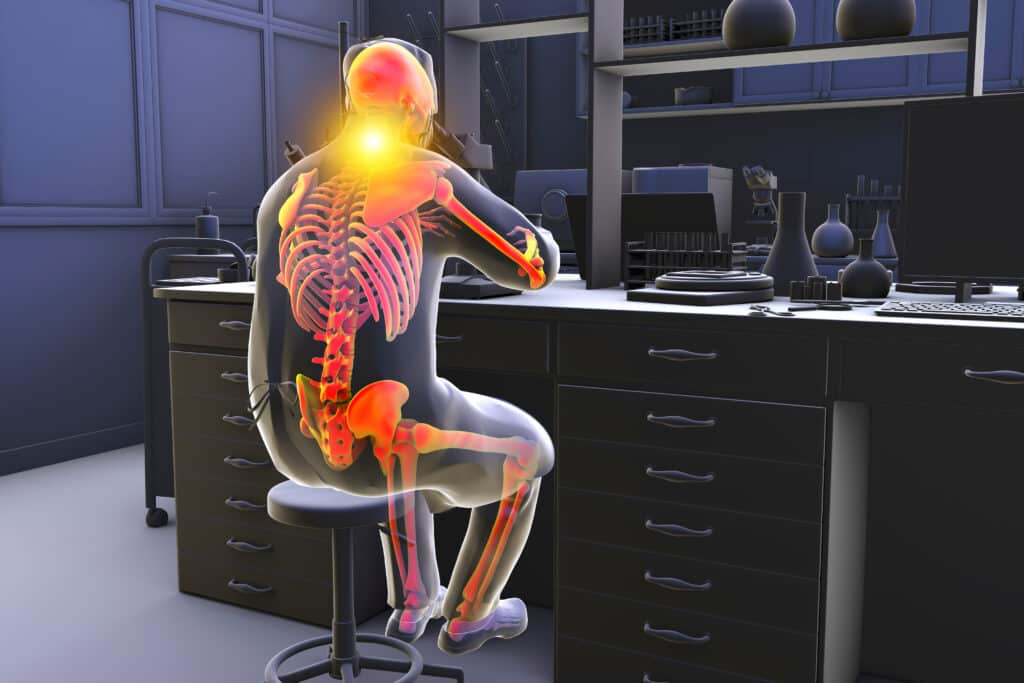
Musculoskeletal injury is common and often attributed to work. The most common is injury resulting in lower back pain. Most musculoskeletal injuries are self-limiting and resolve within a few days with rest and the use of simple over the counter pain killers.
Occasionally musculoskeletal injury is more serious, difficult to treat and results in significant sickness absence from work.
For employers, alleged musculoskeletal injuries can create added problems as these types of injury are difficult to defend if an injured employee makes a liability claim.
Employers should consider liability claims when planning work involving potentially poor posture or hazardous manual handling. They should look to mitigate these risks by implementing proactive control measures.
The two primary reasons for making musculoskeletal injury liability claims are manual handling and poor posture when working at a computer workstation. Both these working practices are covered by specific Health and Safety Regulations and supported by formal Government Guidance. Failing to observe the guidance is often successfully used by the claimant to show negligence on the part of an employer. It is therefore essential that employers follow and incorporate government guidance into normal working practice. I therefore suggest the following first steps:
- Carryout on employment Occupational Health Screening and offer ongoing access to Occupational Health practitioners, to ensure that employees are physically suitable to undertake manual handling or to work at their workstation.
- Ensure that Manual Handling tasks are risk assessed and that suitable methods of safe handling are introduced and continued.
- Ensure Computer workstations are individually risk assessed to ensure that the workstation is comfortable, and that the desk, keypad, and screen can be suitably adjusted to meet the individual User’s needs.
- Ensure that additional measures can be quickly introduced when an employee reports a musculoskeletal injury which may be caused by, or could be made worse by work
- Ensure that injuries reported as being ‘work related’ are quickly and correctly investigated so that causation can be identified, corrective measures can be taken and if indicated, the injury notified (as an accident at work) to the enforcing authority and to insurers. In my experience it is better to notify (even if there is a marginal doubt that the injury occurred at work) and to do this in a timely fashion.
- Those carrying out manual handling or working at workstations should be trained in the safety aspects of their work. This is a statutory duty when manual handling is carried out at work.
- Training should be extended to managers. They should be briefed on for instance, the actions to take when a new manual handling task is identified, a workstation appears unsuitable or when an employee reports concerns or an injury. A significant number of liability cases succeed because a middle manager has failed to recognise the gravity of a certain situation or has chosen to turn a blind eye to it.
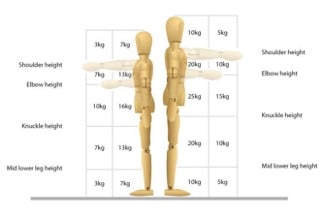
When it comes to Manual Handling, an important factor influencing the outcome of a liability claim can be the weights the employee in question was expected to lift and handle at the material time. Government guidance makes recommendations about the weights an ‘average’ person should lift (see below). The inference (for reasons of the Regulations) being that the employer should consider these weights when making a risk assessment but should also consider for example, individual capability and the complexity of the working task. In Civil liability cases the burden of proof is less than in a Criminal prosecution. If the claimant can persuade the Court that injury was the result of lifting excessive weights at work, over and above the limits described in the guidance, the claim has a good chance of success. Employers should be mindful of this and should seek to keep loads at or about the levels described in the official guidance.
Manual Handling
Think First – don’t act until it is safe to do so!
Use mechanical means of handling whenever possible
Plan your work and consider if the weight of the load is beyond your individual capability. If it is, get help or seek assistance from your manager
Do not lift or handle if you have an injury, seek advice from your manager first
Follow the basic methods for safely lifting and handling (see below)
Use the controls for manual handling listed in the Manual Handling Risk Assessments and follow your training
Pace yourself and rest when tired
Don’t ‘snatch and grab’ at loads
If you do sustain an injury, stop handling, and quickly advise your Manager Wear, safety boots, and protective gloves when necessary.
Avoid twisting or leaning when your back is bent. Keep your shoulders level and facing in the same direction as your hips. Turning your whole body in the direction of travel is better than twisting.
Good Advice for Bad Backs
This information is for people who sustain a back injury and experience back pain.
Most people who suffer back pain sustain a relatively simple injury from which they recover in a relatively short space of time.
Here are some Do’s and Don’ts
Do’s
Do Stay gently active and mobile
Do Take regular ‘over the counter’ pain killers – as indicated on the packet for 24 hours
Do Increase your oral intake of non-alcoholic fluids
Do Keep warm
Do Report your injury to your manager, even if it did not happen at work
Do See your doctor if your pain persists for more than 24 hours or if you notice a change in sensation, the pain becomes suddenly worse, or you are worried
Don’ts
Don’t Take to your bed or lay on a hard surface – normal gentle activity is better
Don’t Try to work through the pain
Don’t Try not to lift or carry beyond your changed capacity
Don’t Avoid telling your line manager that you have pain
Don’t Drink significant amounts of Alcohol or smoke
Always follow your manual handling training and use a safe technique when lifting and carrying
Computer Workstations
What you should do:
- Adjust your chair so that your arms and back are supported, you are at the correct height for your desk and your feet touch the ground
- If your feet can’t reach the ground, use a footrest
- Adjust your monitor so your eyes are level with the top of the screen
- Your mouse and keyboard should be positioned close to you. Your wrists and arms should be supported when using them.
- Keep your desk tidy so there is nothing obstructing the movement of your mouse
- Check regularly that you are not slouching or sitting awkwardly
- Take regular breaks from looking at your screen and from sitting down
- Remove clutter from under your desk so that your legs and feet are not obstructed
- Close blinds etc to lessen glare onto your screen
- Make sure you have adequate light to work comfortably
- Report difficulties with your screen or the software to your manager
If you use a computer for work and could not do your job without it, you are likely to be a ‘User’.All identified Workstation Users are entitled to an annual eyesight test and a contribution to glasses (if required for use with the PC) paid for by their employer. Please ask your employer for further information.