



I have been working years as a safety practitioner for more than 20 years. What follows is based on my experience and my advice to clients.
Most farms will use a tractor. Tractors are items of work equipment and as such employers or those who control workplaces are responsible for ensuring that the equipment is, in all respects, safe. I have chosen 2 causes of workplace accidents involving tractors to illustrate the risk involved and have suggested control measures which may be applied to assist safe operation.
Power Take Off (PTO) Guards
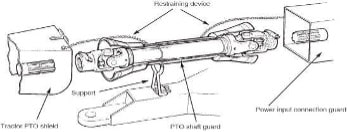
A PTO is a rotating stock or shaft connected to a tractor and used to power agricultural equipment. If someone makes contact with an unguarded PTO there is a risk of entanglement, entrapment and ejection causing horrifying injuries including amputation and death.
See H.S.A’s. video: https://www.youtube.com/watch?v=f7BVNqFi_So
It should be the responsibility of each tractor driver or operator to check the PTO to ensure it is correctly guarded every time it is used. It is the employer’s responsibility to have safe systems in place to ensure that this is done.
Safe System:
- Before checking the PTO and Guard ensure that the PTO is disengaged
- Check to ensure the PTO is guarded along its full length
- Check to ensure the Guard is not damaged
- Check to ensure that the guard is held in place with restraining chains
- Ensure that the chains are connected correctly at each end
- Damaged or missing guards and chains should be replaced before use
- PTO’s with missing guards, defective guards or defective chains should not be used until all is secure and correct
Injection of Hydraulic Fluid Under the Skin
An uncontrolled release of hydraulic fluid, when under pressure, during maintenance or as the result of a leaking line or coupling can cause a major injury if the pressurised fluid contacts with the skin. The injury occurs because the pressurised fluid is injected under the skin. If left untreated the injected oil will cause infection and gangrene.
Safe System:
- All those working on hydraulic lines and systems should know what they are doing
- Hydraulic connections should always be clean and free from dirt
- Hydraulics should not be used if there is a suspicion of a leak or defect
- Hydraulic lines and systems should not be worked on under pressure
- Eye protection should be worn when working on lines and systems
- Hydraulic leaks should not be searched for by using bare hands
- Card or paper can be run over a hydraulic line to identify a leak
- If there is a suspicion that hydraulic fluid has injected under the skin, emergency medical assistance is required
I hope that this information demonstrates to employers that they need to think ‘outside the box’ when considering workplace hazards and how to control them.